



Columbus QuickBooks Bookkeeping Services help small business owners to manage their businesses in smarter ways with the right financial reports. From avoiding cash flow issues and accumulating debt to paying commissions to salespeople.
Using QuickBooks Financial Reports to Understand Your Business
QuickBooks financial reports can help business owners understand what is happening behind the transactions recorded in their books. When the underlying bookkeeping is accurate and reconciled, reports can provide useful information about profitability, cash flow, customer balances, vendor obligations, and other areas of financial performance.
BSC helps Columbus-area businesses organize their bookkeeping and use QuickBooks reports in ways that are relevant to how the business actually operates. Rather than reviewing reports simply because they are available, the goal is to identify the financial information that helps the owner make better-informed business decisions.
Financial Reports Are Only as Useful as the Bookkeeping Behind Them
A financial report is not automatically useful simply because QuickBooks can generate it. Transactions need to be categorized consistently, accounts reconciled, customer and vendor activity recorded correctly, and the report configured around the question the business is trying to answer.
For many small businesses, useful reports may include the Profit and Loss, Balance Sheet, cash-flow information, Accounts Receivable Aging, Accounts Payable Aging, and reports customized around customers, projects, jobs, or other business activities.
The right reporting setup will differ from one business to another. A contractor may care about job profitability, while another business may need closer visibility into customer balances, recurring expenses, or sales activity.
Build a Reporting Routine Around the Numbers That Matter
Business owners do not necessarily need dozens of reports. A smaller set of consistently prepared reports can be more useful when those reports answer the questions management actually needs to monitor.
For example, a recurring reporting process might help an owner review revenue and expenses, available cash, unpaid customer invoices, upcoming vendor obligations, and changes in profitability over time.
BSC can help identify which QuickBooks reports are useful for the business and organize the bookkeeping process so those reports are based on more dependable financial records.

Profitable small businesses came close to bankruptcy due to poor cash-flow management. Make use of QuickBooks Financial Reports and avoid this problem in your business.
Cash Flow: Why Profitability Alone Is Not Enough
A business can appear profitable and still experience serious cash-flow pressure. One BSC client illustrated this problem clearly. The business regularly received customer deposits and incoming payments, but much of that cash was quickly spent while supplier balances and other obligations continued to grow.
As the company closed additional projects, more cash entered the business—but each new project also created additional supplier, payroll, tax, and operating obligations. Because those future payments were not being considered alongside the incoming cash, the available bank balance created an overly optimistic picture of the company’s financial position.
Over time, vendor balances increased and payments became more difficult to manage. The underlying problem was not simply a lack of sales. It was a lack of visibility into the timing of cash coming in versus obligations that still needed to be paid.
Organized bookkeeping and regular financial review can help business owners recognize these patterns earlier. Cash balances, receivables, payables, upcoming expenses, and project commitments should be considered together rather than relying only on the amount currently sitting in the bank.
Using QuickBooks Reports as Part of an Ongoing Bookkeeping Process
Financial reporting is most useful when it is part of a consistent bookkeeping routine rather than something reviewed only when a problem appears. Depending on the business, reports may be reviewed weekly, monthly, or at another interval appropriate to the volume and complexity of activity.
QuickBooks can save customized reports and, depending on the QuickBooks product and reporting view being used, reports can be shared, exported, or scheduled for recurring delivery. The important part is not automation by itself—it is making sure the report contains accurate, relevant information before relying on it for decisions.
Monitor Customer Balances and Upcoming Obligations
Accounts receivable reports can help a business see which customers still owe money, how much remains outstanding, and how long balances have been unpaid. This can make collections and cash-flow planning easier to manage.
Accounts payable information serves a different purpose by helping the business understand what it owes vendors and when those obligations are due. Reviewing receivables and payables together can provide a more complete picture than looking at the bank balance alone.
The usefulness of these reports still depends on accurate bookkeeping. Payments, credits, bills, invoices, and adjustments need to be entered and reconciled correctly for the reports to provide dependable information.
Customize Reports for Different Business Needs
As a business grows, the financial questions it needs to answer often become more specific. Owners may need reports by customer, project, job, product, salesperson, or another part of the business.
QuickBooks allows many reports to be customized and saved so businesses do not have to rely solely on standard report layouts. The appropriate setup depends on the QuickBooks product, subscription, and the way the company’s accounting records are structured.
BSC’s role is to help connect the bookkeeping structure with the information the business actually needs to review.
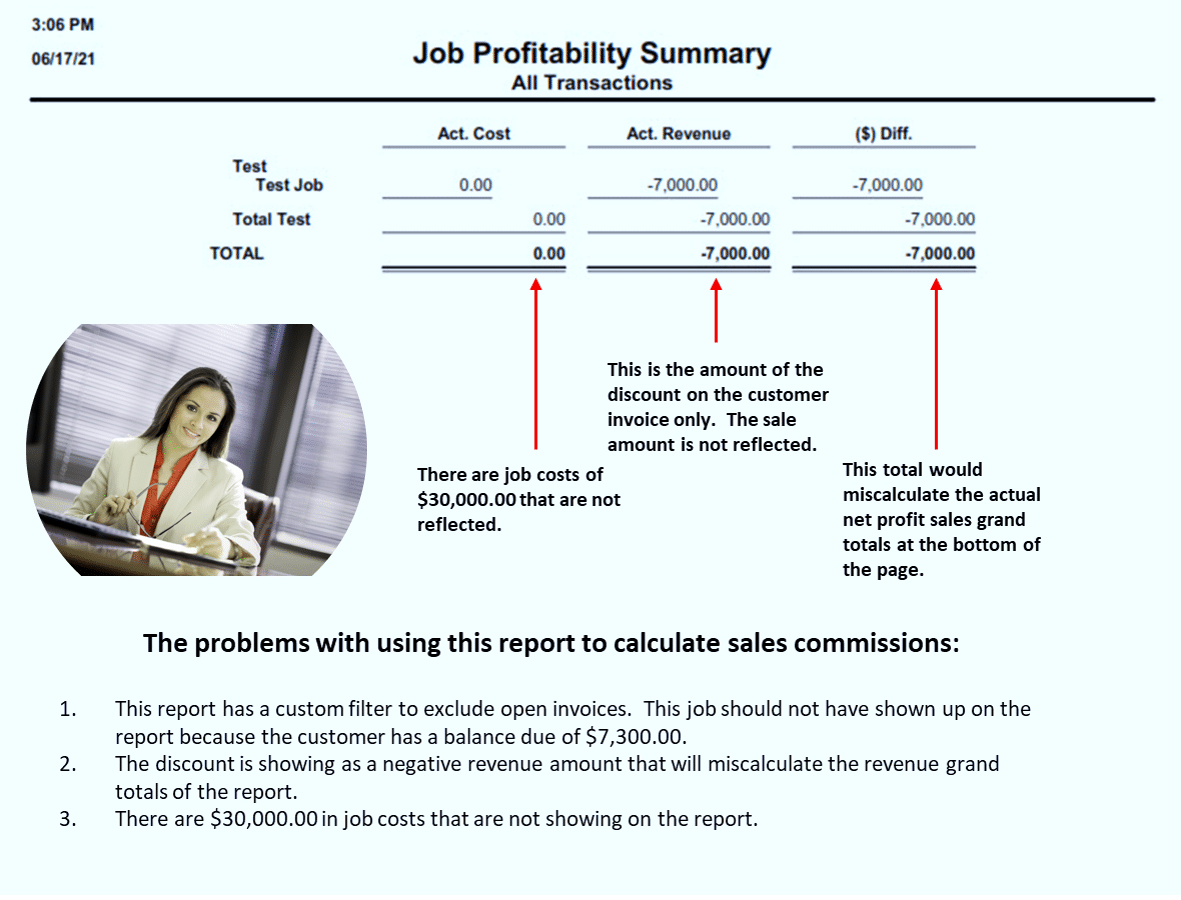
Example of the problems using the standard QuickBooks report to calculate sales commissions.
Case Study: Customizing QuickBooks Reporting for Sales Commissions
A BSC client paid sales commissions based on completed jobs and net profit. The calculation needed to account for factors including customer payments, discounts, sales tax, job costs, credit adjustments, and whether the customer had paid the invoice in full.
The challenge was that a standard QuickBooks report did not, by itself, provide all of the information needed for the client’s commission formula. For example, a report could show activity associated with a sale while not reflecting the complete combination of payments, discounts, job costs, and remaining customer balances required for the commission calculation.
BSC reviewed the reporting process and developed a customized workflow using QuickBooks reporting and a supporting spreadsheet. Revenue and job-cost information could then be reviewed according to the client’s commission rules before commissions were paid.
The lesson is not that a particular standard QuickBooks report is “wrong.” Standard reports are designed for general reporting purposes and may not match every company’s internal compensation formula. Businesses with specialized calculations should define exactly what needs to be measured and then configure the reporting process around those requirements.
.
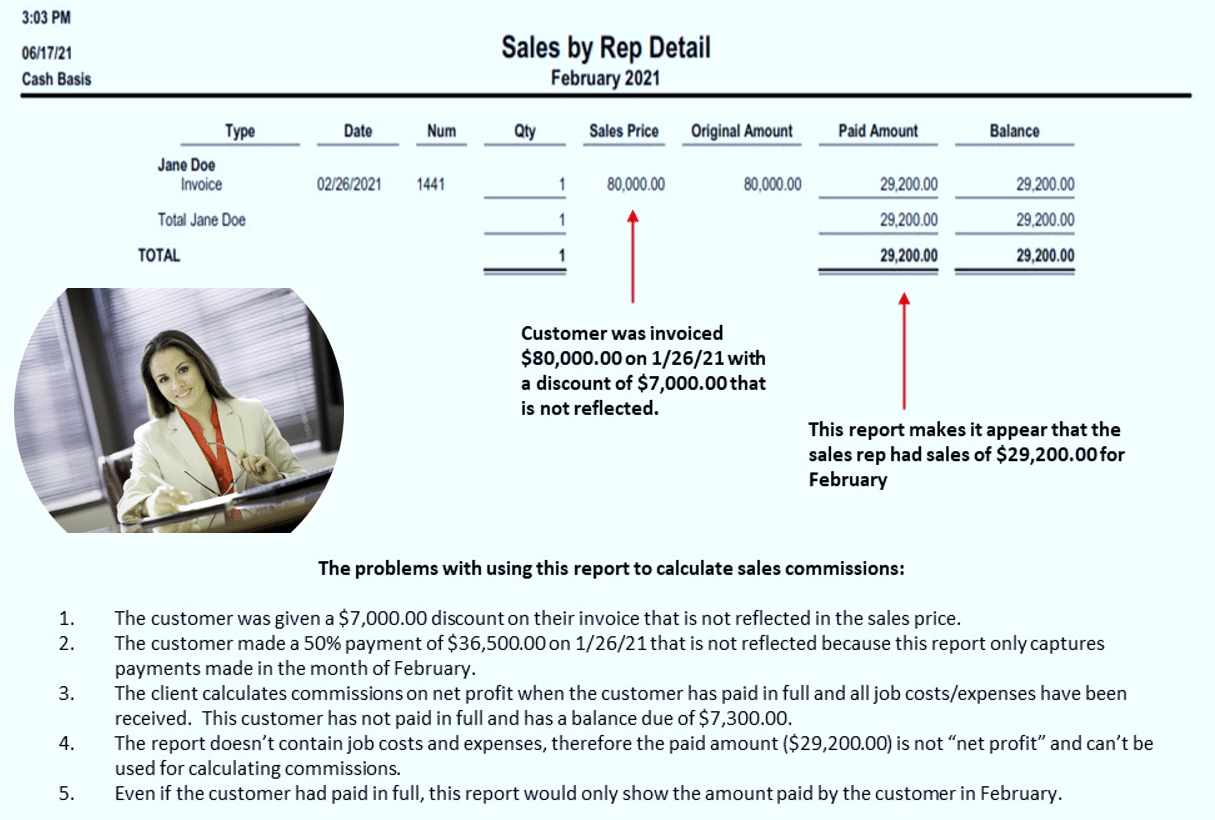
Another example of where standard QuickBooks reports will miscalculate calculate sales commissions.
The Solution – Paying Salespeople the Correct Commission and Making the Company More Profitable
In our example sales reps are paid monthly.
Steps
-
For this client, the reporting workflow included:
- Reviewing sales activity by salesperson and job.
- Confirming customer payments and outstanding balances.
- Adjusting the analysis for discounts, applicable sales-tax amounts, credits, and other relevant activity.
- Reviewing job costs to determine the profit associated with completed work.
- Using the resulting information in the client’s commission calculation.
This gave the business a repeatable process for reviewing commissions using information tied back to its bookkeeping records.

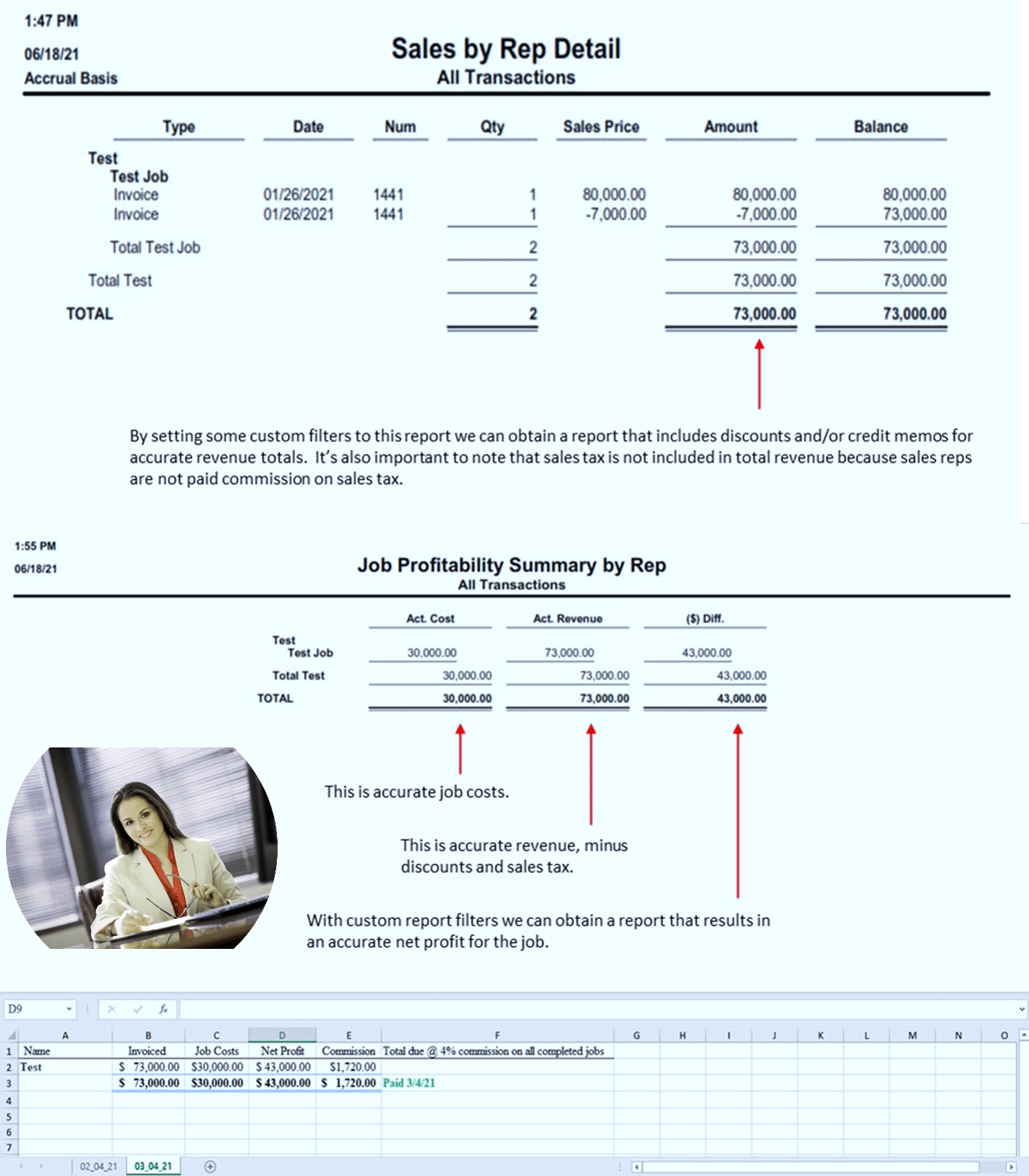
Here is the solution Columbus QuickBooks Services implemented. Salespeople now get the correct commissions based on paid invoices, after discounts, minus job expenses.
Columbus QuickBooks Bookkeeping Services help small business owners to manage their businesses better and more astutely.
From avoiding cash flow issues and accumulating debt to paying commissions to salespeople.
QuickBooks Financial Reporting Support in Columbus
BSC helps small businesses organize their QuickBooks bookkeeping and develop reporting processes that make financial information easier to understand and use. Whether the business needs clearer cash-flow information, receivables and payables reporting, job profitability analysis, or a customized reporting workflow, the objective is to connect accurate bookkeeping with useful business information.
If you need help improving your QuickBooks bookkeeping and financial reports, call Columbus Bookkeeping & Accounting Services at (801) 349-8226 to discuss your current setup and reporting needs.
Or complete our contact form on our Columbus Bookkeeping & Accounting Services homepage.